The human skull is one of the most intricate structures in the human body. It forms the foundation of our face and protects our brain, and its design has evolved over millions of years. These skull facts go beyond the basics you learned in school, covering everything from bone count to the surprising strength of this remarkable structure. Here are seven curious and surprising skull facts that will deepen your understanding of the human skull.
Skull Facts #1: The Skull Isn’t One Solid Bone — It’s 22
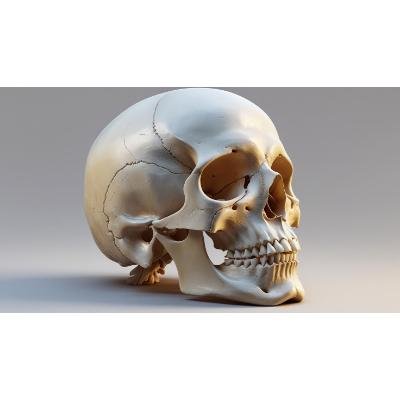
Many people assume the human skull is a single solid bone. In reality, it consists of 22 individual bones fused together: 8 cranial bones that form the protective case around the brain, and 14 facial bones that shape the face. These bones give the skull both flexibility and strength, accommodating growth during childhood and adapting throughout our lives. Each bone plays a specific role in protecting the brain and supporting the face. (Learn more about human skull anatomy in our detailed guide.) Want to see how these 22 bones fit together? Explore our interactive 3D skull model to rotate and examine each one yourself.
Skull Facts #2: Babies Have More Bones Than Adults
A newborn baby has approximately 270 to 300 bones at birth. As the child grows, many of these bones fuse together, and by adulthood the human body typically has 206 bones. This fusion is especially important in the skull — it allows the skull to expand and accommodate the growing brain. The process is called ossification, where cartilage gradually becomes bone. The sutures between skull bones also allow slight movement during childbirth, making delivery safer. Curious about this process in more detail? Check out our full breakdown of the newborn skull.
Skull Fact #3: The Skull Protects More Than Just the Brain
The skull does more than shield the brain — it also provides a protective compartment for vital sensory organs. For example, the orbital bones house and protect the eyes, while the nasal bones form the bridge of the nose and guard the nasal cavity. Meanwhile, the temporal bones protect the structures of the inner ear.
Skull Facts #4: No Two Skulls Are Identical
Overall, every human skull has a unique shape and size. Genetics and environmental factors both influence this individuality, which is why forensic scientists use these differences to identify human remains. They analyze features like the brow ridge, jawline, and cranial dimensions. Skull shape can even reflect cultural practices and ancestral heritage — one striking example is elongated skulls, shaped intentionally by ancient cultures across the world.
Skull Fact #5: The Human Skull Is Incredibly Strong
Despite its relatively thin bones, the human skull is remarkably robust. Research on skull fracture thresholds varies, but most studies place the force needed to fracture a healthy adult skull somewhere in the hundreds of pounds, depending on the point of impact and the direction of the force. This strength comes from the curvature of the skull and the arrangement of its bones, which distribute force evenly across the surface and absorb shock effectively — protecting the brain from everyday impacts.
Skull Facts #6: The Skull Has Several Critical Functions
Beyond protection, the function of the skull includes supporting the muscles of the face and jaw and providing attachment points for chewing and facial expression. It also forms the airway through the nasal cavity and sinuses.
Skull Fact #7: The Skull Is a Powerful Cultural Symbol
Skull shape can even reflect cultural practices and ancestral heritage, and this uniqueness has made the skull a powerful symbol in art, fashion, and design. It’s no surprise that skull aesthetics inspire everything from gothic jewelry, like skull rings, to iconic skull watches for men and women. Here’s a surprising one: most of the “classic” pirate flags you’ve seen — including the ones linked to Blackbeard and Calico Jack — are actually 20th-century inventions, not historical designs. Read the full story in our pirate skull guide.
Want more skull facts and in-depth guides? Explore our full skull information hub for anatomy, history, and shop links.
Skull Facts FAQ
The adult human skull is made up of 22 bones: 8 cranial bones that protect the brain, and 14 facial bones that shape the face. These bones are joined by immovable joints called sutures, except for the mandible (jawbone), which is the only movable bone in the skull.
The skull’s main function is to protect the brain from injury. Beyond that, it also protects the eyes, ears, and nasal passages, supports facial muscles, and provides the structure needed for chewing, breathing, and speech.
The human skull is built to withstand significant force. Estimates for the force needed to fracture a healthy adult skull vary by study and point of impact, but generally fall in the range of several hundred pounds, thanks to the skull’s curved shape and shock-absorbing structure.
No. Every skull is unique, shaped by genetics, sex, age, and even cultural practices. Forensic anthropologists rely on these individual differences to help identify human remains.
Babies are born with around 270 to 300 bones, many of which fuse together as they grow. By adulthood, this number settles at 206 bones. In the skull specifically, this fusion process allows room for the brain to grow during early childhood.
Final Thoughts on These Skull Facts
These skull facts reveal how complex and well-designed the human skull truly is. Scientists continue to study it across multiple fields — anthropologists examine skull shape to understand ancient populations, forensic experts use skull features to identify individuals, and researchers study how the skull protects the brain during trauma. Each field uncovers new skull facts that deepen our knowledge of human biology.
The skull is also a cultural icon, appearing in art, fashion, jewelry, and music across centuries and continents. From Day of the Dead celebrations to gothic fashion, the skull represents strength, transformation, and the cycle of life. Learning these skull facts gives us a deeper appreciation for our own biology — and the remarkable design of the human body.