
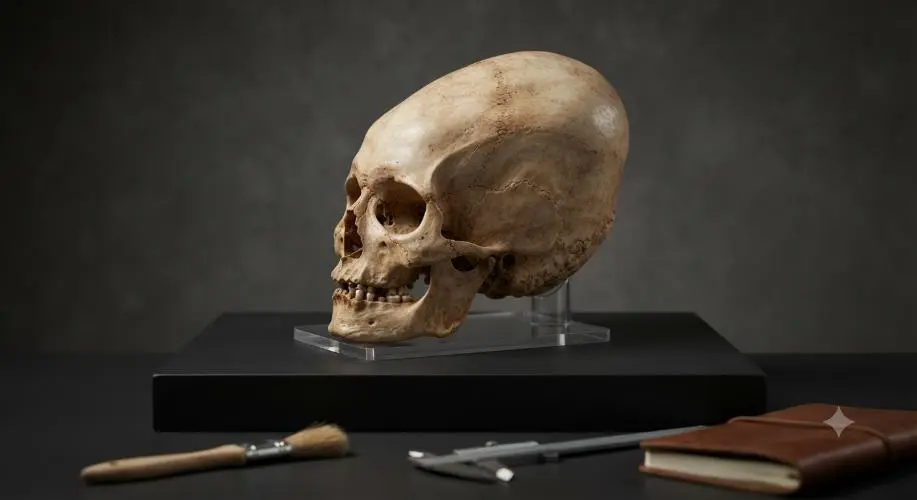
An elongated skull is not evidence of aliens, a lost species, or a hidden chapter of human evolution — it’s the result of a real, well-documented human practice called artificial cranial deformation. For thousands of years, cultures on nearly every continent intentionally reshaped the skulls of their infants. The result: the striking elongated or conical heads seen in museums today. This guide covers the verified history, the techniques used, and the cultures that practiced it — along with an honest look at why the “alien skull” theory doesn’t hold up to scrutiny.
Featured image: Elongated skulls of the Paracas culture, Regional Museum of Ica, Peru. Photo: Marcin Tlustochowicz, CC BY 2.0, via Wikimedia Commons.
What is an Elongated Skull?
An elongated skull is a human skull that caregivers deliberately reshaped during infancy, when the cranial bones are still soft and the sutures between them have not yet fused. By applying sustained, gentle pressure — usually through binding, wrapping, or flat boards — caregivers could redirect the skull’s growth into a longer, more conical shape. This is known scientifically as artificial cranial deformation (ACD), also called cranial modification or head binding. It’s important to note this shaping only affects the skull’s external form. It doesn’t add or remove bone — it simply changes the direction in which the skull grows.
The Elongated Skull: A Practice Found on Every Continent
Artificial cranial deformation is one of the oldest and most geographically widespread body modification practices in human history. The earliest confirmed evidence dates back roughly 45,000 years, to sites in what is now Iraq. From there, the practice went on to appear independently across the Americas, Europe, Africa, Asia, and Oceania. It wasn’t confined to one culture or one era. Instead, it was reinvented again and again by unrelated societies — part of why anthropologists find it so fascinating.
How an Elongated Skull Was Created
Two main techniques were used, often in combination:
- Binding: Caregivers wrapped cloth bandages or cords tightly around an infant’s head over a period of months, gradually guiding the skull into an elongated or rounded shape.
- Cradleboarding: Caregivers placed the infant’s head between two flat boards — one at the forehead, one at the back of the skull — and adjusted the pressure as the child grew.
The process typically began within the first days or weeks of life and continued for several months. After all, the skull becomes far less pliable after the first year. Modern neurosurgical research has found no anthropological evidence linking the practice to cognitive impairment. That said, the psychological and social motivations behind it are far better understood than any physical effects.
Elongated Skull Around the World
The Paracas Skulls of Peru
The most famous elongated skulls in the world come from the Paracas culture of coastal Peru, which flourished roughly between 800 BCE and 100 BCE. Archaeologist Julio Tello uncovered around 300 of these skulls in 1928 at the Paracas Necropolis. Many show an extreme, conical elongation, far more dramatic than typical head-binding practices elsewhere. The Paracas people used tight wrappings and wooden boards, likely as a marker of social status, ethnic identity, or spiritual belief tied to their gods.
The Maya of Mesoamerica
Cranial deformation was widespread throughout Maya civilization. Studies of skeletal remains have found evidence of the practice in the large majority of skulls examined at some sites. Maya parents began shaping an infant’s head within days of birth, most likely for two connected reasons. Many colonial-era and ethnographic sources describe a belief that shaping the head helped protect a newborn’s soul. At the same time, Maya culture also considered an elongated, sloping forehead a mark of beauty and elevated social status, a shape that appears throughout Maya art depicting nobles and deities. Some researchers connect the ideal shape to Yum Kaax, the Maya maize god, linking the practice to the cultural importance of corn.
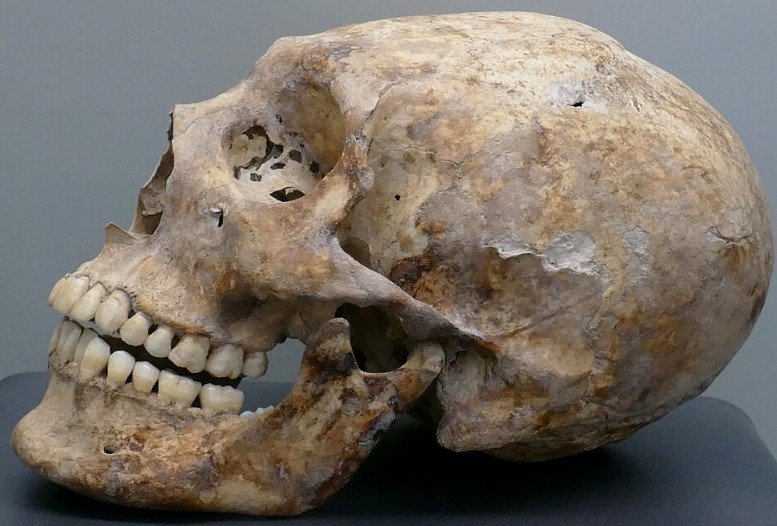
The Huns and Cranial Deformation in Europe
Before reaching Europe, the practice had already spread through Central Asia — cranial deformation is well documented in Sogdiana and Bactria (present-day Uzbekistan and Afghanistan), brought there by the Yuezhi people centuries before the Huns carried it westward.
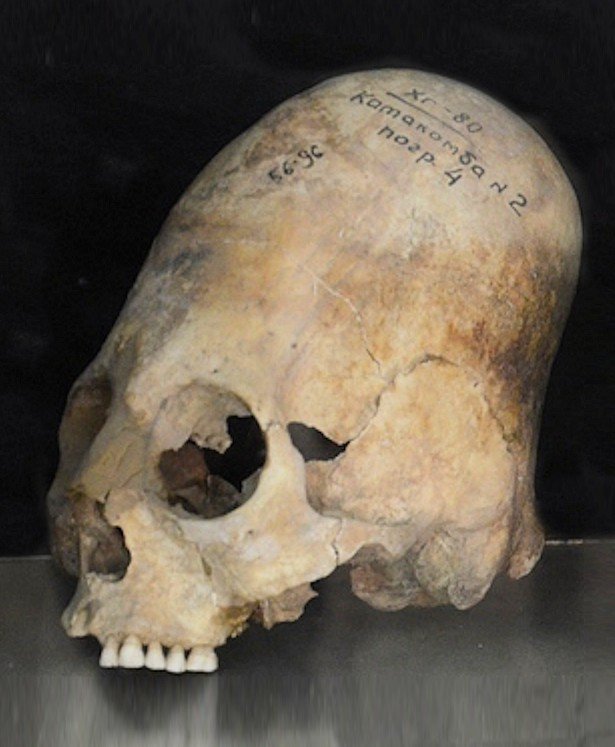
Cranial deformation reached Europe through the Huns and the Alans, nomadic groups originating in Central Asia. They brought the practice with them during their westward migrations in Late Antiquity. Archaeologists have documented deformed skulls from the Migration Period across Hungary, France, and other parts of Central and Western Europe. One striking 5th-century example, unearthed in Alsace, France, belonged to a woman of apparent high status. The practice was also adopted by Germanic groups the Huns came into contact with, including the Ostrogoths and Gepids.
The Mangbetu of Central Africa
In 19th- and early 20th-century Central Africa, the Mangbetu people practiced a form of head-shaping known as lipombo, using tight wrapping to elongate the skull, most often for girls, as a mark of beauty and status. European explorers and ethnographers documented the custom, and it remained visible in Mangbetu art and sculpture long after the practice itself declined.
Other Regions
Anthropologists have also documented cranial modification among Indigenous peoples of North America, including the Chinookan peoples of the Pacific Northwest and groups in the American Southwest; across the Andes beyond Paracas, including the Tiwanaku culture of Bolivia; in parts of the pre-colonial Philippines, particularly among the Visayans and Bikolano; and on the Pacific island of Vanuatu, where some communities describe it as tied to spiritual tradition rather than status.
Why Did Ancient Cultures Elongate Skulls?
The motivations varied by culture, but three themes come up again and again in the archaeological and anthropological record:
- Social status. In many societies, from the Maya to the Andean cultures, a distinct head shape marked out nobility, warriors, or specific family lineages. It was a permanent, unmistakable sign of rank.
- Beauty standards. Numerous cultures considered an elongated or sloped head an ideal of beauty, similar in concept to other historical beauty practices such as foot binding or lip plates.
- Group and spiritual identity. For some communities, head shaping distinguished one ethnic or family group from another. For others, it carried religious meaning tied to local beliefs about the soul, protection, or divine ancestry.
The Paracas “Alien DNA” Claim: Separating Fact from Fiction
No discussion of elongated skulls is complete without addressing the most persistent myth: that the Paracas skulls contain “alien” DNA. The claim traces back to 2014, when independent researcher Brien Foerster announced that an anonymous geneticist had found mitochondrial DNA mutations in Paracas skull samples “unknown in any human, primate, or animal.” The story spread quickly across alternative media, but it doesn’t hold up to scrutiny:
- The researcher never published the results in a peer-reviewed scientific journal — he announced them instead through social media and blog posts.
- Foerster never disclosed the identity of the geneticist who supposedly ran the tests, making the claim impossible to verify or replicate.
- Fact-checkers, including Snopes, found no credible academic source corroborating the claim. Anthropologists who have studied the skulls directly, such as University of Wyoming professor Melissa S. Murphy, confirm their features fall well within normal human variation.
- Ancient DNA is notoriously fragile and easily contaminated by modern handling. This can produce exactly the kind of “unmatched” genetic fragments the claim relies on — a well-known issue in paleogenetics, not evidence of a new species.
Artificial cranial deformation fully explains the elongated shape of the Paracas skulls — the same practice documented on every other continent. The real story is of a sophisticated ancient culture deliberately reshaping the human body to express identity and belief. It doesn’t need an extraterrestrial explanation to be remarkable.
Are Elongated Skulls Dangerous?
This is one of the most common questions about the practice, and the honest answer is that the research is still limited. A widely cited 2007 study in the journal Neurosurgery found no anthropological evidence of cognitive effects resulting from cranial deformation. Skeletal remains showing the practice come from individuals who otherwise lived full lives within their societies. That said, most cultures no longer practice ACD today, in part due to colonization-era suppression and shifting cultural norms. It also differs from modern, unrelated medical conditions like positional plagiocephaly in infants, which pediatricians actively monitor and treat.
Looking for more on skull anatomy and history? Our skull information hub covers anatomy, ancient practices, and cultural symbolism in one place.
Elongated Skull FAQ
Yes. Elongated skulls are real human skulls — caregivers intentionally reshaped them during infancy through binding or the use of flat boards, a practice called artificial cranial deformation. They are not evidence of a different species.
The Paracas culture of ancient Peru is the most famous, thanks to the roughly 300 dramatically elongated skulls found at the Paracas Necropolis in 1928. The Maya of Mesoamerica are a close second, given how widely documented the practice was in their society.
The process used gradual, sustained pressure over months, not sudden force. Caregivers carried it out as a normal part of infant care within these cultures. Modern research has found no anthropological evidence linking the practice to cognitive harm, though it remains an active area of study.
It’s extremely rare today. The practice declined sharply after European colonization suppressed it in the Americas. Cultural shifts elsewhere also led most communities to abandon it by the 20th century, though isolated traditions persisted longer in a few regions.
No. The claim was never published in a peer-reviewed journal, the geneticist involved was never identified, and independent fact-checkers found no credible evidence supporting it. Mainstream anthropologists attribute the skulls’ shape to artificial cranial deformation, the same practice documented worldwide.
Final Thoughts
Elongated skulls are one of the clearest examples of how deeply culture can shape the human body — literally. From the Paracas Necropolis in Peru to Hun-era graves in Hungary and Mangbetu communities in Central Africa, the practice of artificial cranial deformation tells a story about status, beauty, and identity. It’s a story that spans nearly every corner of the ancient world. It’s a genuinely remarkable piece of human history — one that doesn’t need myths about aliens to be worth understanding.
Understanding the real elongated skull phenomenon means understanding human culture itself.
References / Further Reading
- Wikipedia — Artificial cranial deformation
- Snopes — Elongated Skulls Found in Peru Could Be Aliens?
- Journal of Neurosurgery (Neurosurgical Focus) — Artificially deformed crania from the Hun-Germanic Period
- Journal of Neurosurgery (Neurosurgical Focus) — A look at Mayan artificial cranial deformation practices
- PMC / National Library of Medicine — Artificial cranial deformation in Tiwanaku, Bolivia
- Atlas Obscura — Head Space: Behind 10,000 Years of Artificial Cranial Modification