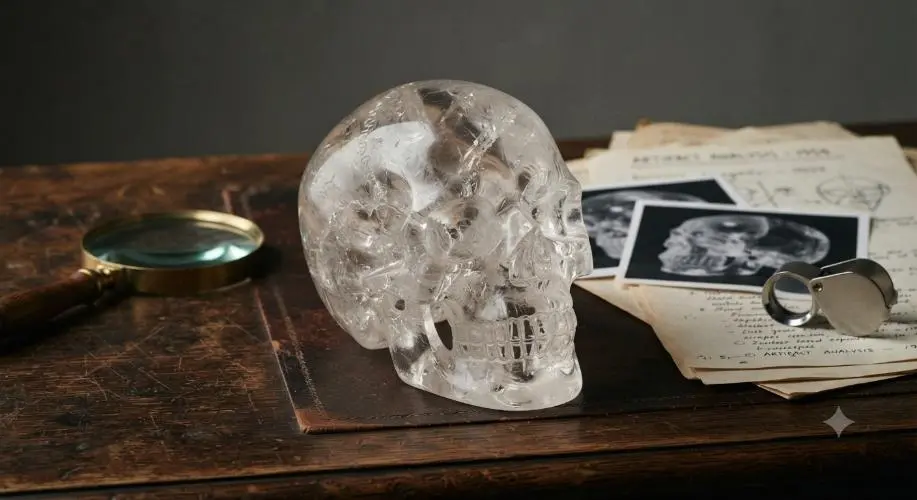
Crystal skulls are life-size and miniature sculptures of the human skull. Most are carved from clear quartz or other colored stones. For over a century, two very different stories have surrounded them. One claims they’re sacred relics of the ancient Maya and Aztec, carrying mystical power passed down through generations. However, museum science tells a different story about who actually made them, and when.
What Is a Crystal Skull?
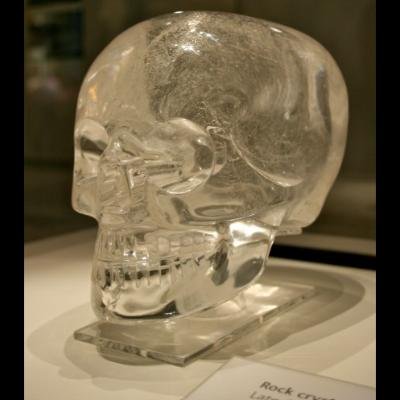
A crystal skull is a carved likeness of a human skull. Most examples use clear or milky quartz, though some use amethyst, rose quartz, or other crystal varieties. Sizes range from small pendant pieces to life-size sculptures weighing several pounds. The best-known examples sit in the Smithsonian, the British Museum, and the Musée du quai Branly in Paris. Craftsmen polished them to a high shine and carved in detailed anatomical features.
For much of the 20th century, museums displayed and discussed these skulls as pre-Columbian Mesoamerican artifacts. Specifically, people believed the Aztec, Maya, or Mixtec made them centuries before European contact. That assumption turned out to be wrong. In fact, the story of how museums figured that out is arguably more interesting than the myth itself.
The Legend of the Crystal Skull
The most famous version of the legend centers on the so-called Mitchell-Hedges skull. Adventurer Frederick Mitchell-Hedges claimed his team found it in 1924 inside the ruins of the ancient Maya city of Lubaantun, in present-day Belize. His adopted daughter Anna told the same story for decades. Consequently, the tale describes the skull as an object of immense power. Some versions link it to a broader legend of “13 crystal skulls,” said to hold the collective knowledge of humanity. According to the myth, they must reunite one day to prevent global catastrophe.
This legend spread widely through books and documentaries. Eventually, it reached pop culture too, most visibly in the 2008 film Indiana Jones and the Kingdom of the Crystal Skull, which borrowed directly from the mythology.
Are Crystal Skulls Real Ancient Artifacts?
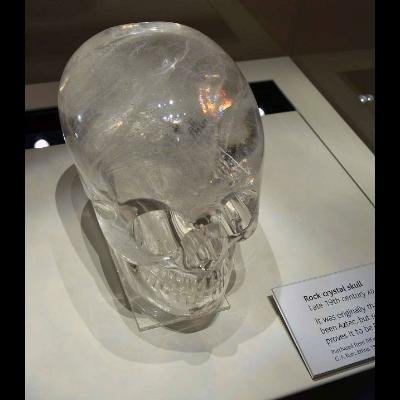
They aren’t. The evidence comes from some of the most respected archaeological science institutions in the world.
Smithsonian anthropologist Jane MacLaren Walsh began investigating crystal skulls in 1992. That year, someone anonymously donated a skull to the National Museum of Natural History, along with a note claiming Aztec origin. Then, Walsh teamed up with British Museum materials scientist Margaret Sax. Together they used scanning electron microscopy to examine tool marks on several major crystal skulls, including the Smithsonian’s, the British Museum’s, the Paris skull, and eventually the Mitchell-Hedges skull itself.
In every case, the marks matched high-speed rotary tools coated with industrial abrasives. Notably, that technology didn’t exist in pre-Columbian Mesoamerica. Traces of carborundum (silicon carbide) confirmed the same thing: this abrasive wasn’t invented until 1891, so the skulls date to well after European contact, not thousands of years earlier.
Walsh’s research also unraveled the Mitchell-Hedges origin story. In fact, records show he bought the skull at a Sotheby’s auction in London in 1943 — not at Lubaantun. Walsh traced the broader crystal skull trend back further, to a 19th-century French antiquities dealer named Eugène Boban. He sold several similar pieces in Europe decades before Mitchell-Hedges acquired his. Walsh documented this history in her book The Man Who Invented Aztec Crystal Skulls.
Neither the Smithsonian nor the British Museum has ever authenticated a crystal skull as a genuine pre-Columbian artifact. Instead, the current scientific consensus says craftsmen made them in the 19th or early 20th century, likely in Europe. Dealers then sold them into museum and private collections as ancient relics.
How to Care for a Crystal Skull
Crystal skulls remain popular collector’s items and spiritual objects today, whatever their true age. Many owners still follow rituals from the crystal healing community. Still, it’s worth noting upfront: science hasn’t verified any of these practices. We present them here as commonly followed beliefs, not proven effects.
Practitioners who follow these traditions often recommend:
- Cleansing the skull under running water, with salt, or with sage smoke. Believers say this, in turn, clears any energy the skull may have absorbed.
- Setting an intention before use, often by holding the skull and focusing on a specific goal or question.
- Storing it away from direct sunlight and heat. This is good practical advice regardless of belief system, since prolonged heat exposure can fade or crack some crystals.
- Cleaning gently with a soft, damp cloth. Avoid harsh chemical cleaners that can dull the surface.
Crystal Skulls by Gemstone
Beyond clear quartz, craftsmen carve crystal skulls from dozens of gemstones. Amethyst, rose quartz, black onyx, labradorite, and lapis lazuli are just a few examples. Notably, each stone carries its own meaning in crystal healing traditions. We cover that full breakdown, gemstone by gemstone, in our guide to gemstone skull meanings.
Want to explore more skull history and anatomy? Head back to our skull information hub to see the full collection of guides.
Frequently Asked Questions
No. Scientists have studied every major crystal skull in depth, including the Mitchell-Hedges skull. Each one shows tool marks from modern equipment. None has ever been authenticated as pre-Columbian.
It’s the most famous crystal skull in the legend. Frederick Mitchell-Hedges claimed his team found it in 1924 at the Maya ruins of Lubaantun. Research by Smithsonian anthropologist Jane MacLaren Walsh found this origin story to be false. Records show he bought it at a Sotheby’s auction in 1943.
It’s the most famous crystal skull in the legend. Frederick Mitchell-Hedges claimed his team found it in 1924 at the Maya ruins of Lubaantun. However, research by Smithsonian anthropologist Jane MacLaren Walsh found this origin story to be false. Records show he bought it at a Sotheby’s auction in 1943.
There’s no scientific evidence that crystal skulls bring luck or hold any special power. Many people in the crystal healing community believe they carry positive energy. That said, this remains a matter of personal belief rather than a verified effect.
Even as forgeries, crystal skulls remain impressive pieces of lapidary craftsmanship. Many collectors and spiritual practitioners value them for their beauty and symbolism. The claim of ancient origin matters less to them than the object itself.
We did the same thing with pirate flags — most of the famous pirate skull designs turn out to be modern inventions too.
References & Further Reading
- Walsh, Jane MacLaren. “Why the Smithsonian Has a Fake Crystal Skull.” Smithsonian Magazine.
- Smithsonian Institution. “Mysterious Crystal Skull on Exhibit for the First Time.”
- Wikipedia’s overview of crystal skulls and the archaeological evidence.
- Wikipedia’s biography of Jane MacLaren Walsh.